
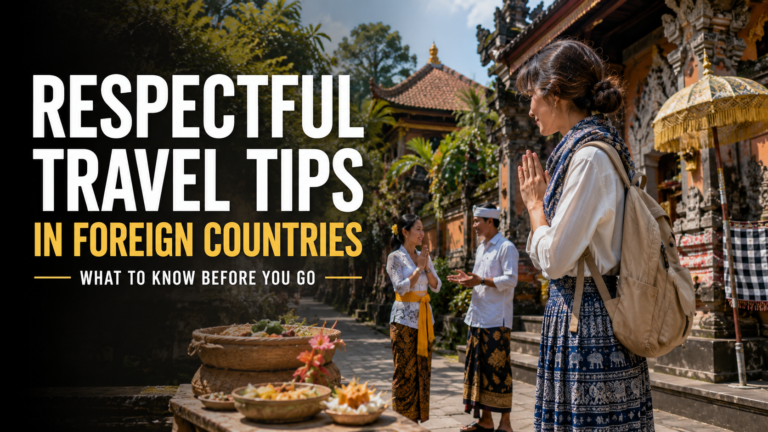
Once, in Tokyo, I handed someone my business card with one hand. Like I was passing a napkin at a diner. The man across from me was too polite to say anything. But I knew right away I did something wrong. In Japan, you use both hands. You also look at the card for a second before you put it away. I just shoved mine in my back pocket. It was just a little thing. It irritates me to this day whenever I reflect on it.
This is the true meaning of respectful travel tips in foreign countries. It’s not about cramming a guidebook full of rules prior to getting on your plane. It’s about being attentive enough not to disregard someone else’s normal.
Do a little homework before you land
You don’t have to go through an entire book before traveling to a foreign nation. Just get a rough idea of the basic knowledge and you will save yourself from many inconvenient circumstances. Learn about the ways to say hello. Learn the customs that are seen as inappropriate. Learn what to expect when eating.
In Thailand, the head is treated very specially. So, touching someone’s head is not something to take lightly. In some areas of the Middle East, the left hand is used for specific hygiene tasks.So eating or handing something to someone with your left hand can look bad, even if you meant nothing by it. A friend told me this after a trip. I cringed thinking back on a few dinners.
Looking up cultural etiquette abroad doesn’t take much work. Just a quick search before you pack. TripVaultGuide has guides for specific countries if you want more detail than what’s here.
Dress for where you are, not where you’re from.
What’s normal at home might not work somewhere else. This trips up a lot of travelers. It tripped me up more than once. Shorts and tank tops feel fine on a hot day. But the right dress code for travel matters a lot at religious sites.In certain areas of Southeast Asia, the Middle East, and Europe, one has to cover their shoulders and knees in order to even enter a room.
I have started carrying a light scarf in my bag.I once got turned away from a temple in Chiang Mai. I had to go buy an overpriced pair of elephant pants just to get back in. It was a costly lesson. A scarf can cover your shoulders, your waist, and also your head if you need it. It is very light in weight and has saved me in many instances before now.
Learn a few words at least.
You need not be fluent. No one expects that from a tourist.. Nobody expects that from a tourist. Hello, thank you, please, excuse me. That’s basically the whole starter kit. Just knowing those words changes how people treat you. It shows that you are trying to speak instead of just assuming that people will speak in their mother tongue when they see you.
I have had several situations where I mispronounced the words. For example in Lisbon one shop owner made fun of my pronunciation when I tried to say “obrigado” but did it with a nice smile. He tried to explain to me how to say “obrigado” for about five minutes. This is one of my fondest memories from the entire journey. It happened simply because I attempted even though poorly.
Eat the way locals eat, not the way you’re used to
Dining customs change more than most people expect.All you should do is to watch what others are doing and imitate their behavior accordingly.An immediate apology will be enough. It is always possible for others to distinguish between mistakes and lack of respect.
Tipping rules differ from place to place.
American travelers get tripped up on this one a lot. Tipping back home is pretty heavy compared to most of the world. Tip in Japan, and you might actually offend someone. It can feel like you’re saying the service wasn’t already good enough. In Europe, it’s usually simpler. Round up, or leave something small. Many places already add a service charge to the bill.
Look up the tipping customs abroad before your trip, instead of guessing. If you overtip, worst case, you look a little clueless, or you get charged more next time. But if you undertip somewhere it’s expected, that can land badly.
Ask before you take that photo.
Everyone feels tempted to take pictures of anything. More so of locals wearing their culture’s attire or unique landscapes. However, many people feel uncomfortable being used as part of the picture-perfect setting. And rightly so. A quick hand gesture, or a smile while pointing at your camera, goes a long way. Some sacred sites don’t allow photos at all. Ignoring a posted sign just to get a shot for your feed makes you that tourist. The one everyone’s quietly annoyed with.
The U.S. Department of State publishes guidance on customs and local laws for each country. It’s worth a look before you visit somewhere new. The UN World Tourism Organization also lays out bigger-picture rules for responsible travel, beyond just etiquette basics.
The short version
Becoming a proper tourist does not mean that one must always be doing everything right. It means being observant, asking questions where needed, and realizing that it is okay to feel awkward sometimes rather than assuming that everything one is used to at home will automatically apply overseas. Most travelers outside one’s home country would not necessarily mind if one made a few mistakes.That’s not a high bar.
If you’re planning your next trip and want more travel etiquette tips by country, TripVaultGuide has more guides worth checking before you pack.
FAQ
What are the most common respectful travel mistakes tourists make?
Wearing the wrong clothes at religious sites. Taking photos of people without asking. Getting tipping or greetings wrong.A lot of this occurs unintentionally due to people’s ignorance as no one informs them about it before they board the aircraft.
Should you learn the local language before travelling anywhere?
You don’t necessarily have to. A few words, hello, thank you, please, get you most of the way there. Even bad pronunciation usually goes over fine. People notice that you tried more than how well you did it.
How do I know if a place requires modest dress?
Mostly at religious sites. Temples, mosques, and churches require some attention to the dressing.If you do not know, it’s a good idea to cover your knees and shoulders. Always have a scarf to use when you don’t know what to do.
Are it impolite to take pictures of locals on a travel?
Yes, with the exception of seeking permission first.Typically, a hand gesture and a smile with the camera held up will suffice.If someone says no, that’s the answer. No need to push.
Does tipping etiquette really change that much by country?
More than most people expect. It’s required in some places, optional in others, and can even seem rude in a few, like Japan. It’s worth five minutes of research before your trip.