
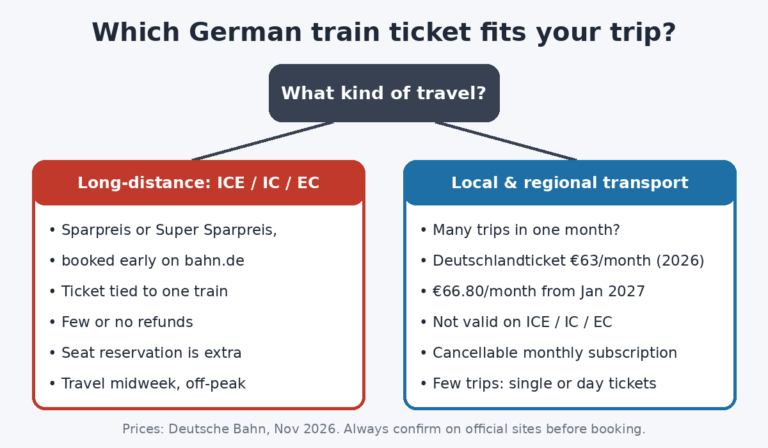
Germany has a reputation for being expensive, and for travellers who walk up to a ticket machine and buy a long-distance ticket for the next train, it often is. But the German rail system also rewards a little planning more than most. If you understand two tools, the discounted long-distance fares sold by Deutsche Bahn and the nationwide Deutschlandticket for local and regional transport, you can cross the country and explore its cities for far less than the “Flexpreis” price on the departure board.
This guide is a decision framework, not a brand roundup. Every price below comes from official sources and was checked in November 2026, but fares are dynamic, so always confirm the price and conditions on the official page before you buy.
Two kinds of trains, two ways to save
German rail splits into two worlds:
Long-distance trains: ICE, IC and EC services run by Deutsche Bahn. They are fast, connect big cities and are priced like flights: the earlier you book, the cheaper it usually gets.
Local and regional transport: regional trains (RE, RB), S-Bahn, U-Bahn, trams and buses. These are slower but cover almost every town, and they are exactly what the Deutschlandticket is for.
The main money levers follow from that split. For long hops, the lever is booking a discounted Sparpreis or Super Sparpreis in advance. For lots of short and medium trips, the lever is a monthly Deutschlandticket. Many budget trips combine both.
DB Sparpreis and Super Sparpreis: cheap long-distance fares
Deutsche Bahn sells long-distance tickets in three main fare types:
Flexpreis: the full, flexible fare. You can take any train on your route that day, and it is the most expensive option.
Sparpreis: a discounted fare tied to a specific train, with some cancellation options.
Super Sparpreis: the cheapest fare, also tied to a specific train, with the strictest conditions.
According to Deutsche Bahn’s own offers page (bahn.de/angebot/sparpreis-flexpreis), discounted fares within Germany start from €6.99 as of November 2026. Treat that as a floor, not a promise. Prices are set dynamically and the cheapest tickets on a popular route sell out quickly. A realistic expectation for a long route booked a few weeks ahead is somewhere between the floor price and a fraction of the Flexpreis, depending on the day and time.
DB also lists variants for travellers under 27 (Super Sparpreis Young and Sparpreis Young) and over 65 (Super Sparpreis Senioren), as well as “Last Minute Sparpreise” for short-notice trips. If you fit an age group, check those options in the fare search before booking the standard fare.
The rules travellers most often miss
Your ticket is bound to your train. A Sparpreis or Super Sparpreis is valid only for the train shown on the ticket. If you miss it through your own fault, you generally need a new ticket. If your train is delayed, the official passenger-rights rules apply, so read the conditions shown at checkout.
Refunds and exchanges are limited. The Super Sparpreis in particular has very limited or no exchange options. Do not book it if your plans are still uncertain.
A seat reservation is separate. A cheap ticket does not include a seat. On busy routes (Fridays, Sundays, holidays) it can be worth paying for a reservation.
Check the exact conditions at checkout. Fare rules change. The conditions shown in the booking flow on bahn.de are the ones that count.
Booking habits that cut the price
Book early. The cheapest fares are released well in advance and disappear as trains fill up.
Travel midweek and off-peak. Tuesday to Thursday and mid-morning departures are usually cheaper than Friday afternoons and Sunday evenings.
Be flexible by an hour or two. The fare search on bahn.de shows prices for different departures, and the difference between two trains on the same day can be large.
Compare split bookings carefully. Sometimes a journey is cheaper as two separate tickets. Only do this using the official fare search, and remember that two separate tickets can carry different protections if you miss a connection.
When the Deutschlandticket is the better buy
The Deutschlandticket is a monthly pass for all local and regional public transport in Germany: buses, trams, U-Bahn, S-Bahn and regional trains (RE and RB), in second class. It is not valid on long-distance trains such as ICE, IC and EC, nor on long-distance coaches.
On price, Deutsche Bahn’s FAQ states that the Deutschlandticket costs €63 per month until 31 December 2026 and €66.80 per month from 1 January 2027. For context, the German consumer federation (vzbv) notes that the price rose from €58 to €63 at the start of 2026, and that from 2027 a cost index will be used to set the price each year.
The ticket is sold as a subscription that you can cancel monthly. The consumer federation points out a practical catch: if you only need it for one month, you have to remember to cancel in time. Check the cancellation deadline of the seller you buy from.
Simple maths for travellers
The Deutschlandticket is worth it when you use local and regional transport a lot in one calendar month. A quick way to decide:
Add up what you would pay for single tickets and city day tickets during your stay.
If that total is close to or above the monthly price (€63 in 2026, €66.80 from January 2027), the Deutschlandticket is usually the better buy.
Remember that it covers every city you visit. One pass replaces the day tickets in Berlin, Leipzig, Dresden and Munich alike.
It also works as a backbone for slower travel. Regional trains can take you between many cities, just more slowly than an ICE. A traveller with time and a Deutschlandticket can cover surprising distances for no extra fare.
Jobticket and student versions exist at reduced prices, but these are tied to employers or universities. If one might apply to you, check with your local transport authority.
Two sample budgets
These examples are illustrations, not quotes. Fares change constantly, so confirm every price on the official sites.
Example A: a city-hopping trip using only the Deutschlandticket. You stay in Leipzig, take a regional train to Dresden one day and to Halle another, and use trams and buses daily. Instead of buying regional tickets and day tickets in each city, one monthly Deutschlandticket covers all of it. Your transport cost for the month is the monthly ticket price, however many local trips you make.
Example B: Berlin to Munich and back for a long weekend. Book two Super Sparpreis tickets weeks in advance on bahn.de, midweek if possible. In Munich, either buy local tickets or, if you already have a Deutschlandticket for that month, use it for the U-Bahn, S-Bahn and trams. The long-distance legs are the main cost, so booking early and choosing off-peak trains matters most here.
How to judge travel “discounts” safely
Travel is full of codes, offers and “was/now” prices. A few habits keep you on the safe side without relying on any particular website:
Get the fare from the carrier. Check prices on bahn.de or the official app of the local transport authority. That is where valid fares and conditions are published.
If a code is not accepted in the official checkout, skip it. A genuine discount shows up as a lower price before you pay. Codes that need you to sign up elsewhere first deserve extra caution.
Watch card and currency fees when paying from abroad. If a payment page offers to charge you in your home currency, compare it with paying in euros. That conversion is often worse than your own bank’s rate.
Ignore markdowns you cannot verify. A hotel or tour price shown as “60% off” means little without a reference price you can check.
Quick checklist before you buy
Which ticket type do I need: Sparpreis, Super Sparpreis, Flexpreis or the Deutschlandticket?
What are the refund and exchange rules for this exact fare?
Do I need a seat reservation on this train?
Is the ticket valid on this train type (long-distance or regional)?
Have I confirmed the price and conditions on the official page today?
The bottom line
Cheap rail travel in Germany comes down to matching the ticket to the trip. For long distances, book a Sparpreis or Super Sparpreis early on bahn.de and accept that it ties you to one train. For lots of local and regional travel in one month, the Deutschlandticket is hard to beat. Skip any “deal” you cannot verify at the official checkout. Bookmark the official Deutsche Bahn offers page and the Deutschlandticket information from your transport authority, and check them again before every trip, because prices in Germany change more often than many travellers expect.
Sources (checked November 2026):
Deutsche Bahn, Sparpreise und Flexpreise: https://www.bahn.de/angebot/sparpreis-flexpreis
Deutsche Bahn FAQ, Deutschland-Ticket price from 1 January 2027: https://www.bahn.de/faq/deutschlandticket-neuer-preis
Verbraucherzentrale Bundesverband (vzbv), Deutschlandticket: https://www.vzbv.de/deutschlandticket
Author bio: Julia James researches everyday travel and shopping prices in Germany.
Site: https://schnellrabatt.de