
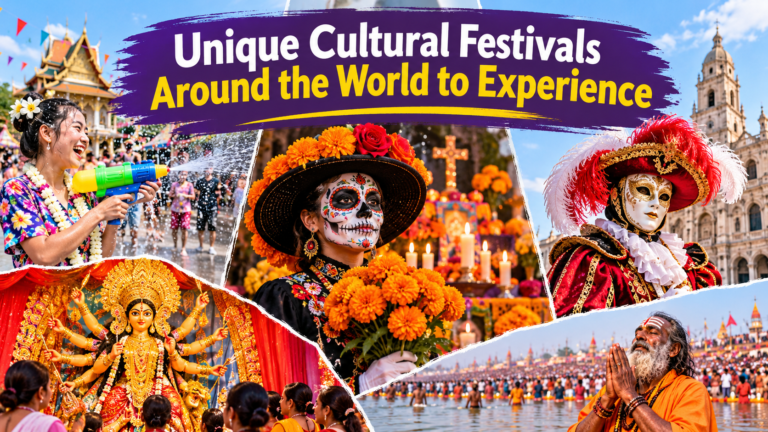
Imagine streets filled with buckets of water in everyone’s doorways, a graveyard at night lit up by candles and orange flowers, or a plaza crowded with dancers wearing costumes beating out rhythms with their wooden shoes. These are not sets from movies; they are festivals, and people have been celebrating them for centuries.
If you like to travel and learn something along the way, then cultural festivals around the world may be the perfect excuse to purchase a plane ticket. The following list presents five festivals with their meanings and some information for travelers. I relied heavily on UNESCO websites for my facts and will make sure to distinguish my personal opinions. I have not participated in any of these festivals, so I do not share any first-hand experience.
How I chose these five
To pick unique cultural festivals around the world with solid sources, I used one rule. All five are on UNESCO’s Representative List of the Intangible Cultural Heritage of Humanity. That’s not a ranking, and plenty of wonderful festivals aren’t on it. But it gave me one reliable, official source for each, and that matters when the goal is to get the facts right. The rest of this guide, including the tips, is my own view.
Songkran in Thailand
The Songkran festival is the traditional New Year of Thailand. This UNESCO committee inscribed the festival into the List in December 2023. The UNESCO decision regarding the Songkran festival is presented below. According to the decision, it takes place in the middle of April after the harvesting of rice and lasts from three to seven days.
Water plays an important role in the celebration. UNESCO says that the pouring of water means cleansing, reverence, and prosperity. However, there is more to the festival than just that. There is house-cleaning and decoration, making merit in the temples, giving alms to monks, bathing Buddha images, building sand pagodas, playing games, music-making, and feasts.
UNESCO says families reunite, ancestors and elders are honored, and the festival even “helps to combat loneliness and social isolation.”
So yes, expect to get wet. Just remember it’s a blessing before it’s a water fight. That last line is my own view.
Day of the Dead in Mexico
UNESCO has classified the holiday under the title of the “Indigenous festivity for the dead” in 2008. This festivity is performed in different countries in the end of October and beginning of November, to represent the “transitory arrival of dead people on Earth.”
The family helps their deceased relatives and friends to come back home by putting flower petals, burning candles, and offering the dead items. During the celebration, people put the favorite food of their dead relatives near home altars and tombstones. As the proper source claims, this tradition is a combination of pre-Hispanic religion and Catholicism. Now, here is my opinion: this is a family gathering rather than a spooky celebration.
The Carnival of Binche in Belgium
Binche’s carnival, inscribed in 2008, runs for the three days before Lent. Shrove Sunday starts it, and Mardi Gras is the climax. On that last day, after a ritual dressing ceremony, “several hundred Gilles sporting red, yellow, and black costumes” parade through town to the beat of the drum.
UNESCO says their outfits include ostrich-feather hats, wooden clogs, bells, and wax masks with small spectacles.This event climaxes in the dancing of the Gilles in the Grand Place accompanied by fireworks. This event is also described as being characterized by spontaneity and the locals being proud of the craft used to make the costumes, dance and music. There are no oranges mentioned here, so there will be no oranges mentioned here.
Durga Puja in Kolkata, India
Durga Puja in Kolkata joined the list in December 2021. According to the decision, small workshops shape clay images of the goddess Durga using clay from the Ganga River. Worship begins on Mahalaya, when the eyes of the images are painted to bring them to life. Over ten days the goddess is honored, and on the last day the images are immersed in the river.
The festival also features large installations and pavilions in the city, along with traditional Bengali drumming. UNESCO notes that crowds move through them and says, “The divides of class, religion, and ethnicities collapse.” It calls the festival an example of “the public performance of religion and art.” That’s a lot of art in the street, and you don’t need a ticket to see it. That last remark is my own.
Kumbh Mela in India
Kumbh Mela was inscribed in 2017. UNESCO calls it “the largest peaceful congregation of pilgrims on earth” and says “millions of people reach the place without any invitation.” Pilgrims bathe in a holy river; according to UNESCO, the believers think that a bath in the Ganges will cleanse them of sins and rebirth.
The web-page of UNESCO states that it is celebrated “every four years by rotation in four cities of India namely Allahabad, Haridwar, Ujjain, and Nasik.” There are different cycles for different Kumbh festivals, however, so you may check the calendar for your year and city. That’s my own note, and I haven’t verified the schedule.
Among the unique cultural festivals around the world, this one takes the most planning because of the crowds. It may suit experienced travelers better than first-timers. That’s my opinion.
How to visit with respect
These tips are my own, not from UNESCO.
- Keep in mind that these are not entertainment programs; they are religion, family, or community of some people.
- Always ask before you take photos of people, altars, or any rituals.
- Dress according to the place you are visiting. Usually, temples and graveyards require modest clothing.
- Take your cue from the locals; if they remain quiet, do so as well.
- Learn some words in the local language; even a “thank you” will be enough.
- Do not use sacred objects as a tool or as a memento.
Special events in unique cultures across the globe suit tourists best when they behave as guests.
Planning without stress
The planning process for unique cultural festivals around the globe is best initiated by looking at dates, which can be flexible. For example, some festivals may be celebrated on the basis of religious or lunar calendars. Therefore, you should verify dates every year before making flight bookings. Hotel rates will increase and rooms may become scarce due to heavy crowd at these festivals; hence, it is recommended that you plan accordingly. All of this is general knowledge, not from a source.
If you’re watching your budget, our guide to the cheapest way to travel in the USA has money-saving ideas you can adapt for trips abroad.
Common mistakes
The first big mistake people make with unique cultural festivals around the world is viewing them as tourist destinations. Other common mistakes include making reservations too late, disregarding photo etiquette, wearing improper clothing, and expecting that the dates are the same each year.
Your next step
Select one of these unique cultural festivals around the world and research their exact dates next year. Check flight and accommodation options even if the trip is a long way off – having a date to plan your trip around is always good.
For more trip ideas, browse our cultural travel section. Unique cultural festivals around the world let you step into a community’s own story, so go with curiosity, patience, and respect.
FAQ
What are some unique cultural festivals around the world?
Five of them that have been identified by UNESCO include Songkran in Thailand, Day of the Dead in Mexico, Carnival of Binche in Belgium, Durga Puja in Kolkata, and Kumbh Mela in India.
When does Songkran take place?
According to UNESCO, Songkran occurs mid-April and lasts from three to seven days.
When is Day of the Dead?
UNESCO specifies that Indigenous celebration occurs annually at the transition from October to November.
Is it possible for tourists to visit distinctive cultural events worldwide?
For the most part, yes. In particular, according to UNESCO, millions of people arrive at Kumbh Mela uninvited.
Is UNESCO recognition a ranking of the best festivals?
No. It’s a listing of cultural practices that communities want to safeguard. Many great festivals aren’t on it.